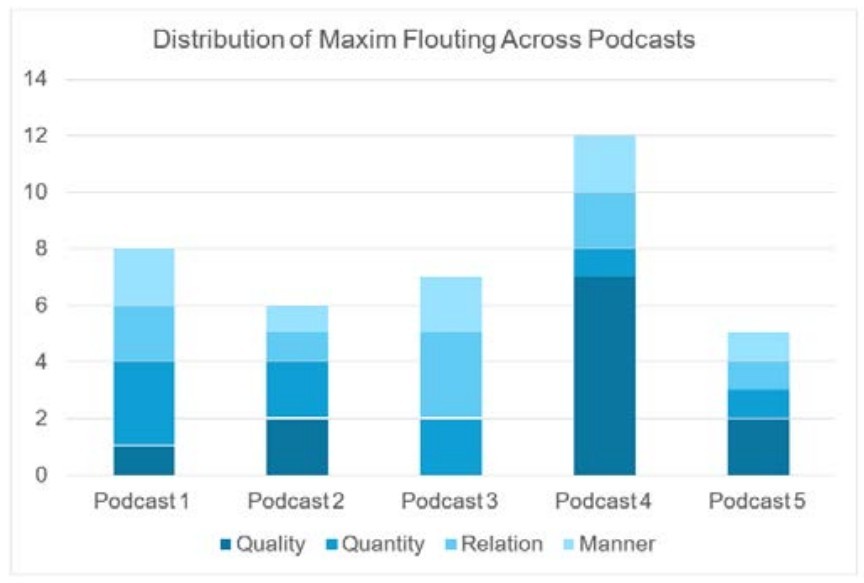
The study examines how Grice's Cooperative Principle and conversational maxims operate in authentic spoken discourse, focusing on five educational podcasts published on the platform Spotify between the years 2024 and 2025. Drawing on pragmatic theory — including conversational implicature and Relevance Theory — it is investigated how and why speakers flout the Quality, Quantity, Relation, and Manner maxims in real-life communication. The empirical analysis combines qualitative analysis of communicative function with a quantitative count of flouting instances. A total of thirty-eight instances of maxim flouts are identified, classified, and evaluated. Contrary to the initial hypothesis, flouting of the Maxim of Quantity is not the dominant pattern. The findings indicate that flouting is rarely a communicative failure; rather, it functions as a purposeful strategy that generates implicature, emphasizes emotion, and increases listeners’ engagement without undermining mutual understanding. The study concludes that conversational maxims function as flexible, adaptable guidelines rather than fixed rules, and that authentic materials of this kind hold considerable value for developing learners’ pragmatic competence in teaching and learning contexts while also informing related fields including translation studies, intercultural communication training, media discourse analysis, and the design of conversational AI systems, highlighting its relevance for both theoretical and applied linguistic research.
Source: Leláková, Eva; Červeňáková, Veronika (2026). Flouting Grice’s Conversational Maxims: A Linguistic Study of Authentic Podcast Discourse. Media Education (Mediaobrazovanie). 22(3): 413-424.
Source web-site: https://me.cherkasgu.press/journals_n/1789234623.pdf
Number of views: 111