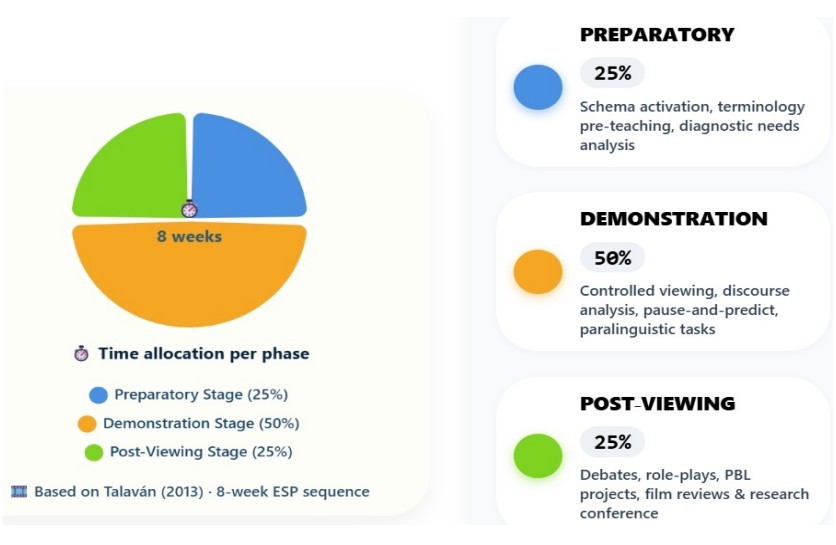
This study integrates media education into English for Specific Purposes (ESP) acquisition by examining feature films' methodological potential for developing media literacy. Using One Flew Over the Cuckoo's Nest (Forman, 1975) as a multimodal case study, the research proposes a threephase pedagogical framework — preparatory, demonstration, post-viewing — to optimise film-based language acquisition and critical media analysis. Grounded in Situational Language Teaching and media education theory, the framework fosters four media literacy competencies: access, analysis, evaluation, and creation of media content. Empirical data were collected from 16 second-year university students across three disciplines (psychology, philosophy, philology). Findings indicate that integrating feature films into ESP curricula enhances media education by fostering learners' ability to decode, evaluate, and create multimodal professional discourse. The framework supports holistic ESP acquisition while promoting critical engagement with institutional power dynamics, narrative strategies, and ideological subtexts. Film-based learning offers motivational benefits, simulating authentic professional interactions in a dynamic, multimodal environment. Feature films catalyse both linguistic competence and media literacy, bridging theoretical knowledge and real-world communicative demands. These results contribute to media education by offering a replicable model for integrating audiovisual media into ESP acquisition in higher education.
Source: Abramova, Viktoriia; Boulahnane, Saad (2026). Integrating Media Education into ESP Acquisition: A Multimodal Case Study of One Flew Over the Cuckoo’s Nest. Media Education (Mediaobrazovanie). 22(3): 347-358.
Source web-site: https://me.cherkasgu.press/journals_n/1789049603.pdf
Number of views: 118